


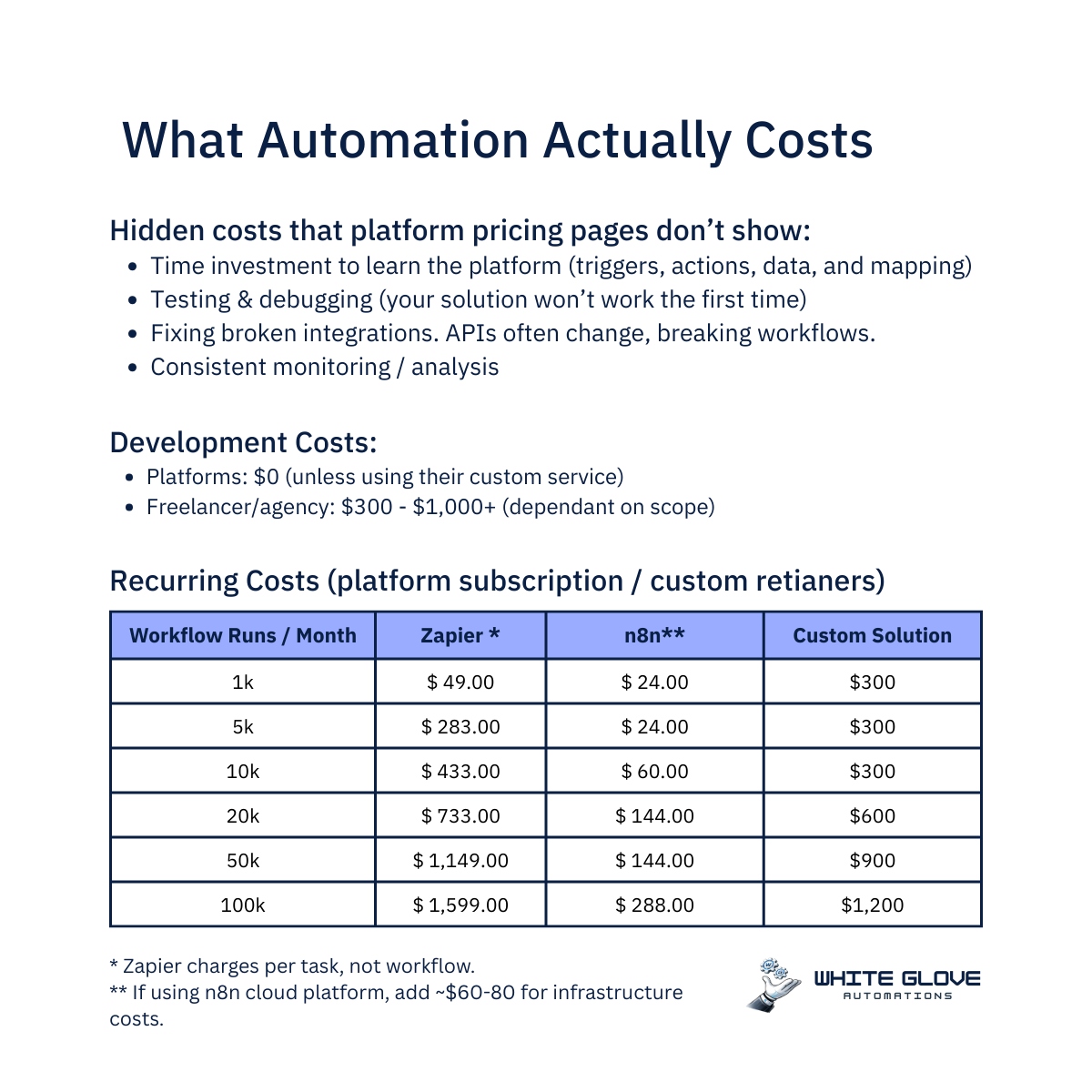
Most SMBs underestimate the real initial and recurring costs of workflow automation.
Automation platforms like Zapier, Make, and n8n make it look simple to connect apps and build workflows, but the actual cost goes far beyond the monthly subscription.
Before committing to an automation strategy, SMBs should consider all costs associated with building and maintaining a solution:
Hidden platform costs:
- Learning new automation platforms takes time
- Testing workflows takes time
- Debugging failures takes time
- Maintaining integrations takes time
Even when the platform itself is affordable, the time investment can become expensive, especially for founders without a technical background.
Development costs for custom solutions:
- Custom workflows require development fees, which can be expensive upfront. The scope also needs to be clearly defined before implementation, and changes must be managed as the system evolves.
For higher-volume businesses, this often becomes more predictable and more scalable.
Monthly cost vary at different workflow volumes:
- Zapier and Make charge per task / operation, while n8n pricing depends on execution volume or hosting setup.
- Typically, custom solution retainers cover infrastructure, maintenance, monitoring, and ongoing refinement.
- At low volume, automation platforms are usually the cheapest option.
- At medium volume, costs between platforms and custom solutions start to overlap.
- At high volume, custom automation is often more cost-effective and more reliable.
The right choice depends on:
- Workflow complexity
- Execution volume
- Required reliability
- Available time to manage the system
There is no one-size-fits-all solution, but there is usually a clear best option once you look at the full cost instead of just the subscription price
If you’re evaluating automation for your business and want help choosing the right approach, feel free to reach out.